
LEDs (light emitting diodes) are solid-state lighting devices that produce light when a direct voltage is applied. An LED is a semiconductor diode packaged in transparent epoxy or silica gel. The diode contains two slightly different materials: P type semiconductor and N type semiconductor P. P type semiconductor has the voids created by the lack of electrons, which create a positive charge.
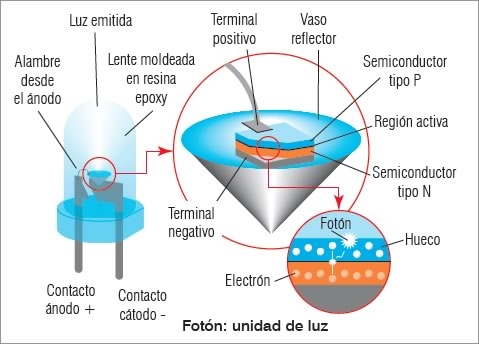
However, the N-type semiconductor has an excess of electrons, which produces a negative charge. N type and P type semiconductors are located in direct contact in the diode, and the region where they are found is known as the PN junction. When the electricity flows through the device, the electrons move into the P region and the holes into the N region.
Near the PN junction, electrons and holes are combined and electrons give off the extra energy gained from electricity. This energy is released as a photon, the basic unit of light. Thus an LED emits visible light. The photon energy corresponds to the colour of the light emitted. In the spectrum of visible light, blue and violet light are obtained from higher emissions of light while the red and yellow from the minors.
By using materials with different band gaps, engineers can alter the power output and consequently the colour of the light produced by an LED. The LED bulbs use a real base plate to operate and are made of electronic components. Basically, they could be considered electronic devices. This technology advances quickly because of the development of new materials.
The demand for lighting products with this new technology is increasing day by day, and we will see its costs reduced as well as the LEDs production increases.
In 1962 it was created the first LED device. Its creator was Nick Holonyak, one of the engineers of General Electric. However, this type of device did not enjoy great popularity until a few years ago, when the Japanese scientist Shuji Nakamura discovered, in 1993, a more economic formula to create blue light by using Gallium Nitride and Indium Nitride.
The importance of this discovery is that the production of red and green light, despite being easy and cheap, was not enough to create the necessary white light we use, for example, to see the computer screen. For the manufacture of white light it is necessary to mix equal parts of red, green and blue light.
Thus, if we approach the screen and observe in great detail, we see that it is made up of thousands of tiny dots of these three colours. As stated above, the LED devices can emit light of a wide range of colours. However, those that emit infrared light are called IRED (Infra Red Emitting Diode).
These devices are widely used in everyday appliances in our homes, such as sound equipment and all kinds of remote controls.
Low heat emission, low infrared or ultraviolet radiation, low temperature light sources much cooler in contact, improving comfort in the rooms where it is installed and saving in conditioning systems.

| FEATURE | TRADICIONAL | LED |
|---|---|---|
| Noise/Flickering | Yes | No |
| Useful life (hours) | 2.000 – 15.000 | 50.000 |
| Useful life (years) | 1 – 2 | 5 |
| CO2 reduction | No | Yes |
| Mercury / Phosphorus | Yes | No |
| Radiation /UV /IR | Yes | No |
| FEATURE | TECHNOLOGY | |||||
|---|---|---|---|---|---|---|
| LED | INDUCTION | METAL HALIDE | HIGH PRESSURE SODIUM VAPOUR | HIGH PRESSURE MERCURY VALUE | TRADITIONAL FLUORESCENCE | |
| Useful life (hours) | 50.000 | 60.000 – 100.000 | 6.000 – 20.000 | 24.000 | 3.000 – 6.000 | 8.000 – 12.000 |
| Light efficiency (Lm / W) | 90 – 140 | 80 | 75 | 80 – 120 | 50 | 70 |
| Power factor | >0.4 | >0.9 | 0.44 – 0.67 | 0.44 | 0.44 – 0.67 | |
| CRI | >85 | >80 | 65 – 90 | 80 | 45 | 70 |
| Deterioration in 2.000 hours | 5% | 5% | 40% | 30% | 45% | 25% |
| Flickering | No | No | Yes | Yes | Yes | Temporary |
| Energy saving | Excellent | Excellent | Low | Normal | Low | Low |
| Surface reached temperature (ºC) | <80 | <80 | >300 | >350 | >300 | <100 |
| Weak point | Without filament or gas, there are not common weaknesses | Without filament, there are not common weaknesses | With filament, weakness in the electrode | With filament, weakness in the electrode | With filament, weakness in the electrode | With filament, weakness in the electrode |
| Start | Momentary | Momentary | 4- 8 minutes | 4- 8 minutes | 4- 8 minutes | <3 seconds |
| Re-encendido | Momentary | Momentary | 8 – 12 minutes | 8 – 12 minutes | 8 – 12 minutes | <1 seconds |
| Environment | Without pollutant, long life with few replacement | Low concentration of mercury, recoverable in solid state. Long life with few replacement | Mercury and lead, low duration with multiple changes | Mercury and lead, low duration with multiple changes | Mercury pollution, low duration with excessive changes | Mercury pollution, low duration with excessive changes |
LEDs are solid-state devices (SSL, Solid State Lighting), so they will not burn. An LED has no filament or other mechanical parts with can break or fail by “blown”, it has only a progressive degradation throughout its life. In fact, it begins to fade gradually.
As time progresses, the cost of spare parts for fluorescent or incandescent bulbs can lead to significant savings by turning them into LEDs. While LED lights may have a higher purchase price, the additional cost will be balanced out by:
LED lights are designed to replace traditional bulbs directly, using the same connectors you already own. The installation process is as simple as replacing a light bulb with the other.
LED lights, in order to replace halogen lamps, consume 90% less energy and last 20 times longer. A 5W LED bulb can replace a 35W dichroic halogen, producing the same level of light.
| TYPES | |
|---|---|
| E | Edison thread type |
| B o BA | Swan or bayonet base type |
| C | Circular tube pressure contact |
| G | Simple pressure screw terminals contact |
| GX | Reinforced pressure screw terminals contact |
| GU | Screw terminals contact for light bulbs with rear calorific emission protection |
| GZ | Screw terminals contact for rear calorific high emission light bulbs |
| R | Bases for straight light bulbs with simple terminals |
| Rx | Bases for straight light bulbs with reinforced terminals |
| Fa | Bases for straight light bulbs with male terminal |


A 22W LED tube can replace a 58W fluorescent tube, by producing the same light level. Practical example: A customer asks us how long it will take him to get a payback on his investment, after have replaced 1,000 58W fluorescent tubes (150 cm) in a parking lot. We suppose that the amount of the investment comes to 32,000 Euros.
We replace 58W tubes (64W with reactance) with 22W LED tubes. When working 365 days a year 24 hours a day, the consumption is 84,096 Euros / year for the 58W tubes and 28,908 Euros / year for the 22W substituted ones, with an assumed average energy cost of 0.15 Euros / KWH. Therefore, the annual savings amount to 55,188 Euros / year. If we add the replacement costs during one year (assuming a 10% of molten tubes) the savings amount to 55.838 Euros / year, or what it is the same 4653.17 Euros / month.
Therefore, with regard to the initial investment we obtain an amortization of it in 6.88 months, just a little more than half a year.
Luminous flux: the rate of luminous flux per unit time, especially the visible luminous flux<, expressed in lumens. Brightness: luminous intensity of any surface in one direction, measured by surface units of projected surface viewed from that direction.
Colour temperature: colour measurement expressed in Kelvin (K). The smaller the value in Kelvin, the hotter or more yellow the light will be. The higher the value, the colder or bluer the light will be.
Luminous intensity: the luminous flux density measured by solid angle in a given direction relative to the emitting source. The traditional unit is the candle, the SI unit is the candela.
Protection value (sealing): IP code or value defined in the international standard IEC 60529 which classifies the level of protection provided by electrical appliances against the intrusion of solid objects such as dust, accidental contact or water.
Luminous efficiency: the ratio of total luminous flux emitted, in lumen, between the total electric power consumed in watts.
Illuminance: lighting power density, also called lightning. A lumen of luminous flux incident uniformly in one square foot area produces a lighting of a foot-candle. In SI units, a lumen of luminous flux incident uniformly on an area of one square meter produces a lightning of one lux.
Glow: the sensation produced by the brightness within the visual field that is sufficiently greater than the brightness to which the eyes are adapted. Glow can cause blurred vision, physical discomfort, headaches or loss of visual capacity and visibility.
LED (Light Emitting Diode): Light Emitting Diode (semiconductor diode that emits light). Lumen: A unit of luminous flux. Total amount of light emitted by the light spot.
Lux: Basic measure of illuminance = amount of light that reaches a surface = lumen / surface
